
atelier 13 audio
GRIMM AUDIO PA1
GRIMM AUDIO PA1 CLASS A/B MONO POWER AMPLIFIER
“Absolute pristine audio playback with an extreme authority in the bass, true to life mids and clean transient highs.“


Grimm Audio PA1
$ 26,500 / pair
GRIMM Audio - PA1
Monoblock Power Amplifier
The PA1s sound relaxed and unhurried, but definitely not slow or thick. They are highly lyrical and engaging, very articulate, nimble, and dynamically expressive. They can be incredibly fast, but only if the music requires it. They don’t always sound fast, which can translate to a dry or staccato rendition or shortened decay. Impressively, despite their communicative nature, they never shout or try to impress.
Instead, these amplifiers disappear altogether, and you simply forget about them. And that is the highest praise I can give an amplifier. The PA1s aren’t cheap, but we can honestly say : Nothing in that price range comes close !
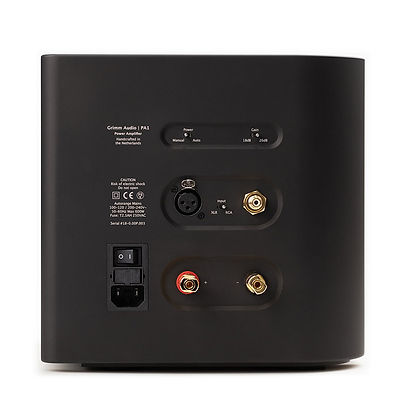
The Grimm Audio PA1 is a Class AB mono-block power amplifier, and the first amplifier Grimm Audio has built in its thirty-year history. Each PA1 drives a single channel with more than 150 watts into 8 ohms, using a fully balanced circuit of 96 fast output transistors and a linear power supply. It was engineered as the power partner for the MU2, and shares that streamer's compact chassis by industrial designer Michiel Uylings.
Key Features of the Grimm Audio PA1
-
Class AB mono-block design, one chassis per channel
-
More than 150 watts into 8 ohms
-
96 fast power transistors on an aluminum circuit board, the "Pierick Amp" output stage
-
Fully balanced signal path with no series coupling capacitors
-
Linear power supply with an Amplimo toroidal transformer and 90,000 µF of reservoir capacitance
-
Selectable gain of 26 dB or 18 dB to match low- and high-gain preamplifiers
-
Balanced XLR and single-ended RCA inputs
-
Automatic line-voltage switching and auto on/off standby
-
Five-year limited warranty
Grimm Audio's First Power Amplifier
Grimm Audio built its name on digital and on decades of work in professional mastering: the MU1 and MU2 music players, the CC1 and CC2 master clocks. The PA1 began because the company struggled to find an amplifier that did justice to the MU2 in demonstrations. Prototypes appeared at Munich High End in 2023, and several years of refinement followed. The amplifier is named the Pierick Amp, in honor of engineer Henk ten Pierick, whose 1985 circuit concept forms its foundation. As Grimm Audio creative director Eelco Grimm puts it, "We have developed a solid-state amplifier capable of achieving an extraordinary combination of transparency, control, and musical naturalness."
The Pierick Amp Output Stage
At the heart of the PA1 are 96 small, fast power transistors mounted on a modern aluminum printed circuit board. The tight thermal coupling that aluminum provides holds the output stage at a precisely defined operating point. In Grimm's words, this gives "an extremely well defined power output stage setting point, through which the output stage impedance remains constant over the full cross-over region, resulting in the lowest possible distortion of dynamic signals." It is a Class AB design that behaves, through the critical crossover region, far more like the best of Class A.
A Linear Power Supply
The PA1 uses a traditional linear supply rather than a switch-mode design. A large Amplimo toroidal transformer was chosen for its minimal capacitive coupling to the mains, feeding 90,000 µF of reservoir capacitance for abundant current on demand. Separate local stabilization keeps the driver and feedback circuits working independently of the current the loudspeaker draws, so dynamics stay clean under load.
A Direct, Balanced Signal Path
The input path carries no series coupling capacitors, and protection circuitry keeps relay contacts out of the speaker signal path. Dedicated feedforward correction reduces phase-modulation distortion, the subtle time smearing that occurs when signal amplitude changes, and a second-order feedback loop lowers remaining distortion without reintroducing it. The damping factor exceeds 800, for tight control of the loudspeaker.
Grimm Audio PA1 Specifications
-
Balanced design throughout
-
Extremely low residual cross-over distortion
-
No coupling capacitors
-
Extensive protection circuitry
-
XLR and RCA inputs
-
Auto on/off function
-
Gain: 26 dB or 18 dB (selectable)
-
Linear power supply with automatic line voltage switch
-
Power: >200 W in 4 Ω
-
THD: <0.0001 % (1 W, 8 Ω)
-
SNR: 96 dB (1 W, 8 Ω)
-
Weight: 15 kg
-
250 x 250 x 240 mm (W x D x H)
-
5 year limited warranty
Grimm Audio PA1
$ 26,500 / pair
Highly Recommended Companion :
Grimm Audio MU2
USB > AES-EBU / SPDIF Interface / Converter (aka DDC)
$ 1,400
We strongly recommend including the LSi with the purchase of the UC1.
It is no secret that the AES interface format delivers superior SQ vs USB ... this, as Clocks operate far more efficiently in the AES environment.
Many audiophile servers only offer USB output, and if such servers need to be used with the UC1, the issue that arises is that the sample rate auto-sensing and switching is far more seamless when connecting to the UC1's AES Digital inputs ... resulting in a sound quality and an overall musicality [fabulous timing] that is truly mesmerizing !
Yes, there are less costly DDC interfaces available on the market, but this one incorporates the same Grimm Clocks as used in the UC1, the MU1 and the MU2. ... for a perfect Clock-to-clock hand off !



Set-Up Video
GRIMM AUDIO
UC1


SAMPLE VIDEO
GRIMM AUDIO UC1
Courtesy of Alpha Audio
Netherlands
SAMPLE VIDEO
GRIMM AUDIO UC1
Courtesy of Alpha Audio
Netherlands
... what they say ...
ALPHA AUDIO
Jaap Veenstra | November 2021
Why are we testing a studio pro audio converter again? Or even better: a universal converter that can convert analog to digital and digital to analog.
With 1001 ways to switch it. What use is this to you – the hi-fi enthusiast? Well… that’s a very good question. The Grimm UC1 intrigued us; so we wanted to check it out and listen to it. And we’re glad we did!
There are simply put some devices that you plug in and…. it just adds up. In fact, there is very little to say about them because everything just falls into place.
And the Grimm Audio UC1 definitely falls into that category ... as do the Grimm TPM and SQM interlinks, ther Driade Flow speaker cable … and we could name a few more like that. But well: a review that just says :
"this Device is just right" … is more than a bit boring of course.
In short : we’re going to see what else we can tell about it.
A lot of Functions
The Grimm Audio UC1 is a Universal Converter. And a headphone amp, pre-amp and master clock. Damn… that’s a lot of functions in one box. True. But fortunately Grimm doesn’t believe in price gouging. It will not offer a bargain of the century, only to skimp on quality here and there. No. For €4000 (ex VAT) you buy a complete product that in fact does everything right.
To give an idea : As a DAC chip Grimm Audio has deployed an AKM 4396VF. And there are three in there (one per stereo pair). The ADC is a wonderful TI PCM4202. Internally we see, of course in a seperate housing, some famous clock crystals with circuitry. The extra housing ensures both thermal stability and it prevents resonances (the crystal is encapsulated by the way).
In one of our FLIR-image tests we did not see the clock glowing, but a heatsink doing its job. The heatsink is between the shunt regulators and the bottom plate. Thus, the UC1 is passively cooled ... and therefore it is quiet.
A few inputs and outputs
Note: this will be a long list. UC stands for Universal Converter. On the back are three sets of analog outputs: 1+2, 3+4 and 2nd Out. These can also be used as multichannel outputs. Then there is a USB input for 10 channels. Up front is another HI-Z input (line), a headphone out and a usb input (stereo) ... for headphones and laptops. Then we see on the back an analog input, two AES3 digital inputs, an AES3 output and an LS1 control port. Last but not least :
a clock-in and a clock-out. Oh, and a remote bus.
As an audiophile DAC ?
Now the question naturally arises : what is the point of having such a Swiss army knife for use at home ? We would rather ask : Why not?
These kinds of devices are made to achieve an incredibly neutral reproduction. Without “embellishment” and unnecessary expense. Think of a sleek cabinet or an ultra-modern and luxurious screen. Instead, you get a 1U enclosure (1 unit height in a server rack, about 4.5 centimeters) with only functional buttons and a menu where you, as a home user, set things up once and then don’t have to do anything except adjust volume.
The goal of studio equipment is mostly to provide maximum quality for a reasonable amount of money. It does not focus on luxury ... It focuses on quality.
And there’s a lot to be said for that, although we wouldn’t be quick to put a pair of austere studio monitors in the living room, because even in those cases, the eye also wants something to appreciate. However, the Grimm UC1 is certainly not an unpleasant device to look at. In fact, it just looks good. The ‘ears’ that we have on it for rackmount can be replaced for ‘hi-fi’ ears. And what remains is a sleek device that is quite acceptable.
Ease of use?
Well, OK ... We’ll get further into how the Grimm UC1 sounds later.
Spoiler alert … it sounds very nice… Of course, what’s also important :
How easily does such a studio converter work ?
Honestly : it takes some getting used to in the beginning. Partly because this device is not directly aimed at the ordinary consumer. There are studio functions in it that are of no use to you as an audiophile (and that you probably do not understand). For instance, consider the comparison function for two inputs. This is useful for studios, because sometimes they want to test effects. Or what about "foldbacks" (what is that you may ask ?) and routing of inputs and outputs?
You – as a home user – just want to select an input and throw it out through one output ... logical. But, that is possible ... You select a ‘monitor source’ via the menu and choose an output. This will be usually analog 1+2 OUT, but you can also control another amplifier, or set of active speakers, via analog 3+4 OUT. And then there is another one : "2nd out". You can also select a source by pressing and turning the volume knob. Handy !
The ‘monitor source’ is the source you want to listen to. In our case the ROON streamer. And the output goes into the Bryston. So, switching the input is simply via the menu –> monitor source. Or via pressing / turning the volume knob. If you want to listen to the headphones you can just press the volume knob and ‘click’ : the headphones come on.
The Test Set-Up
Basically, the Grimm Audio UC1 replaces the Pass Labs XP-12 and the Pavane. However, we listened with and without the Pass Labs. This is because we are curious to see how good the output of the Grimm UC1 is and what, if anything, the Pass Labs can add.
As source we used the Alpha Audio PC with Mutec MC3+. The Mutec MC3+ USB sends a digital signal via XLR into the Grimm UC1. This makes it analog and thus sends it to either the Pass Labs XP-12, or directly into the Bryston 4B SST3.
As speakers we use the Focal Sopra No1. Cabling is a mixture of Driade Flow, Grimm TPM, homebrew and Audioquest. The system is connected to a Kemp HiPower 8 plus and an Isotek Titan filter. The Grimm UC1 runs on the latest firmware that was available (1.1.0).
The Sound
As we mentioned in the opening of the article, there are those devices where there is incredibly little to complain about. In this case, for 4800 euros including VAT, you get a real Swiss army knife in your listening room. A pre-amp, headphone amp, dac, adc and master clock. At a high level.
Purist device
The Grimm Audio UC1 is intended for studios looking for a versatile converter for monitoring. An ultra-transparent, high-end switch box to switch between various monitoring systems. Think two sets of speakers and headphones.
In short : the Grimm UC1 should not add any color. And it doesn’t, in our estimation. We hear – when coupled directly to the Bryston – a very complete and clean picture. Nothing distracts, nothing gets in the way. Everything feels particularly balanced. The imaging is not too big, not too small, and it is tight
and is in perfect focus.
When we put the Pass Labs in between, we don’t immediately hear a different sound, but we do hear that the Pass "puts it down" a little bigger. A little more “hi-fi” shall we say. Is that a bad thing? No, not at all ... many enthusiasts will appreciate this about the Pass Labs. To be honest, so do we.
And this feeling of bigger, and a bit more ‘hifi’, we also have with the Metrum Acoustics Pavane DAC. The difference between the UC1 and the Pavane is quite big. Especially in terms of focus. Is it good Versus bad? No. It’s more a matter of taste. The Grimm UC1 presents as being more focused; the Pavane plays a little bigger with a different kind of stage.
Analogue in
By the way, it’s pretty funny to put an analog source into the UC1. We put the analog output of the Pavane into the analog input of the UC1, and then set the clock at 192 kHz ... because we have to, otherwise it will stay silent. In all other cases it is more convenient to indicate that the UC1 has to take the clock of the source. Anyway, in this configuration we hear a lot of the signature of the Pavane. However, it is fair to say that it is not really one-to-one, although we do hear much of the timbre and focus of the Pavane. Perhaps this has to do with NOS / over- upsampling differences. What we can distill from this is that the A/D conversion is of a high level. And certainly good enough for many an analog device at home. Whether it is suitable for studio use we dare not state; we are not studio engineers. And this review deals with home use.
Calmness
Now your editor is very much a fan of neutral sounding systems. The reason is simple : music should speak for itself. The engineer behind the controls makes the choices for warm, cool, imaging, placement, et cetera. A system should not do that itself. The danger is that all albums sound the same because of the "sauce of the set". And that can’t be your intention, right?
Another thing a good system brings is peace and calmness in the reproduction. A system – and the room! – that sounds balanced and keeps things tight, lets the music be heard. And no more than that. This sounds very logical ... but realize that this is quite rare ... an incredible amount can go wrong in a reproduction chain. Think of resonances in a speaker, acoustic errors, distortion in an amplifier, phase issues throughout the chain, and so on.
Now there is no perfect system (yet). Every designer has to make concessions somewhere. This may be because a certain price point must be met, or because something is not yet technically possible. And this is where the strength of a designer comes in :
-
How well can someone make concessions ?
-
How does an engineer maintain the intended quality ?
-
How well can he or she make choices ?
We believe that with the UC1, Grimm has put an incredibly high-performing device on the market. So good, and yet so incredibly versatile, that it can also be an interesting device for the home user. It sounds musical, honest, insightful, fluent, and can in fact do everything. And that is just a very big accomplishment when we look at the price tag.
And if we are being very honest : it is in fact comparable to the (more expensive) Pavane when it comes to musical quality… oef… yes… really !
For Whom ?
We can be very brief. The Grimm Audio UC1 is the most versatile converter we’ve had in our listening room. And that’s not surprising: at its core, it’s a Studio Converter. If we however "convert" it to high-end audiophile concept terms, it is a Preamplifier, a DAC, an ADC, a headphone amplifier .... and a Masterclock !
This does not make it the ideal partner for everyone, because who needs a high-quality analog to digital converter, and a Masterclock at home ? [ ...our comment on the Clock at Atelier 13 audio : We do ... with our CEC TL 2N CC Transport }
However, this makes it a device that will appeal to many fans of special things.
A person who does not go for ease of use per-sé -- because, no : it is not the most convenient device for the home user -- but a person who is looking for something a bit ‘quirky’. And with that, this enthusiast gets a super versatile device with a beautiful playback characteristic in the house. Pure, controlled and super smooth.
In short : do you like something crazy in the audio rack ? Go crazy ! :
Pick up a Grimm Audio UC1 and be surprised.
Conclusion
A studio device for the home ? Yup ... we thought : why not ?
The Grimm UC1 is a true Swiss army knife, developed for the studio. But the reproduction is so good that we did not want to withhold it from you. For just under 4800 euros, you get an incredibly good sounding and versatile device.
Not the easiest to use, but oh my ... What a quality ... Alpha Approved!


